How to Build an Omnichannel Marketing Strategy on Klaviyo
Think about the last time you discovered a product from an Instagram ad, added it to your basket on your phone, then completed the purchase from a reminder email on your laptop later. You probably didn't think much about it, but that's the point.
Your customers move fluidly between channels. They browse socials, read reviews on their browser, open emails, and then buy through your website. But does their experience feel seamless throughout? Or does it feel like they're dealing with three different brands?
Omnichannel marketing closes that gap.
In this guide, I’ll walk you through everything you need to build an omnichannel strategy that works well, from what it means to how it differs from simply being "on multiple channels" and how to use Klaviyo to tie it all together.
What is omnichannel marketing anyway?
“Omnichannel” has become one of those terms that gets used everywhere, but is rarely explained in a useful way. For a lot of ecommerce brands, I think it’s either a vague ambition to be everywhere all at once (email, SMS, ads, WhatsApp, push) or something they think requires a huge team, complex tech and months of setup to get right.
In reality, it’s much simpler.
Omnichannel marketing is about creating a connected experience for your customers, regardless of where they meet your brand. It means unifying your channels with consistent messaging and branding, so all those little micro-interactions feel like they’re part of the same conversation.
It’s not about being present on as many channels as you possibly can (more on that in a moment). What you really want from an omnichannel strategy is to make sure the channels you are on talk to each other, i.e., share data and respond to what the customer has already done.
If someone just bought from you, they shouldn't be getting an Instagram DM with a discount code for that exact product two hours later. If a customer browsed a category but didn't buy, the follow-up email they receive shouldn’t push generic new arrivals (it should remind them of that category).
Omnichannel puts the customer behaviour at the centre, rather than brand presence, and builds everything else, channels, messaging, data, around them.
Omnichannel vs multichannel: what's the difference?
These two terms get used interchangeably a lot, but they actually describe quite different approaches and confusing them is how you end up with a fragmented customer experience.
Multichannel marketing means being present on multiple channels (remember, I said I’d get back to this). So you've got email, SMS, social, maybe a physical store. Each channel is active and doing its job. Sounds good on paper, but the problem is those channels tend to operate independently. Your email agency is running one strategy, your social team is running another, and you're just managing to hold down all your website updates on your own. Basically, your customers are getting different messages everywhere they show up, sometimes even conflicting ones.
Omnichannel marketing is about building the connective tissue between a multichannel marketing strategy. It makes your brand identifiable, whether a buyer is only now learning about you on socials or interacting with your website further along in the buyer journey.
Your customers expect a seamless experience now, and if you don’t deliver, they’ll go somewhere where they do actually feel seen, like straight into the waiting arms of your competitors in their DMs.
Does every ecommerce business need an omnichannel strategy?
Not every business needs a fully built-out omnichannel strategy, especially from day one. But a lot of ecommerce businesses are closer to needing one than they think. The longer you wait, the harder it becomes to retrofit it later.
If your customers are only ever discovering you, buying from you, and engaging with you through a single channel, omnichannel probably doesn’t need to be a priority right now. You can continue focusing on nailing that one channel first.
But realistically, that describes very few ecommerce businesses. Most already operate across several touchpoints, even if you haven't formalised how those channels connect.
Omnichannel customers shop more, stay loyal longer, and deliver higher value than single-channel customers. So even if you're a smaller brand, the moment you start acquiring customers across multiple channels, the way those channels work together starts to directly impact your revenue and retention.
There are a few signals that tell you it's time to start thinking seriously about omnichannel:
Your customers regularly interact with your brand across multiple channels before they buy.
You're running email and SMS but they're not informed by the same data or strategy.
You're seeing a drop-off in your customer journey but can't pinpoint exactly where.
You're investing in acquisition but struggling to retain the customers you've already won.
Shoppers wanting a cohesive and trustworthy ecommerce experience isn’t something that scales with your business size. A customer buying from a small DTC brand has the same expectations as one buying from a major retailer. The difference is just how sophisticated your execution needs to be to deliver it.
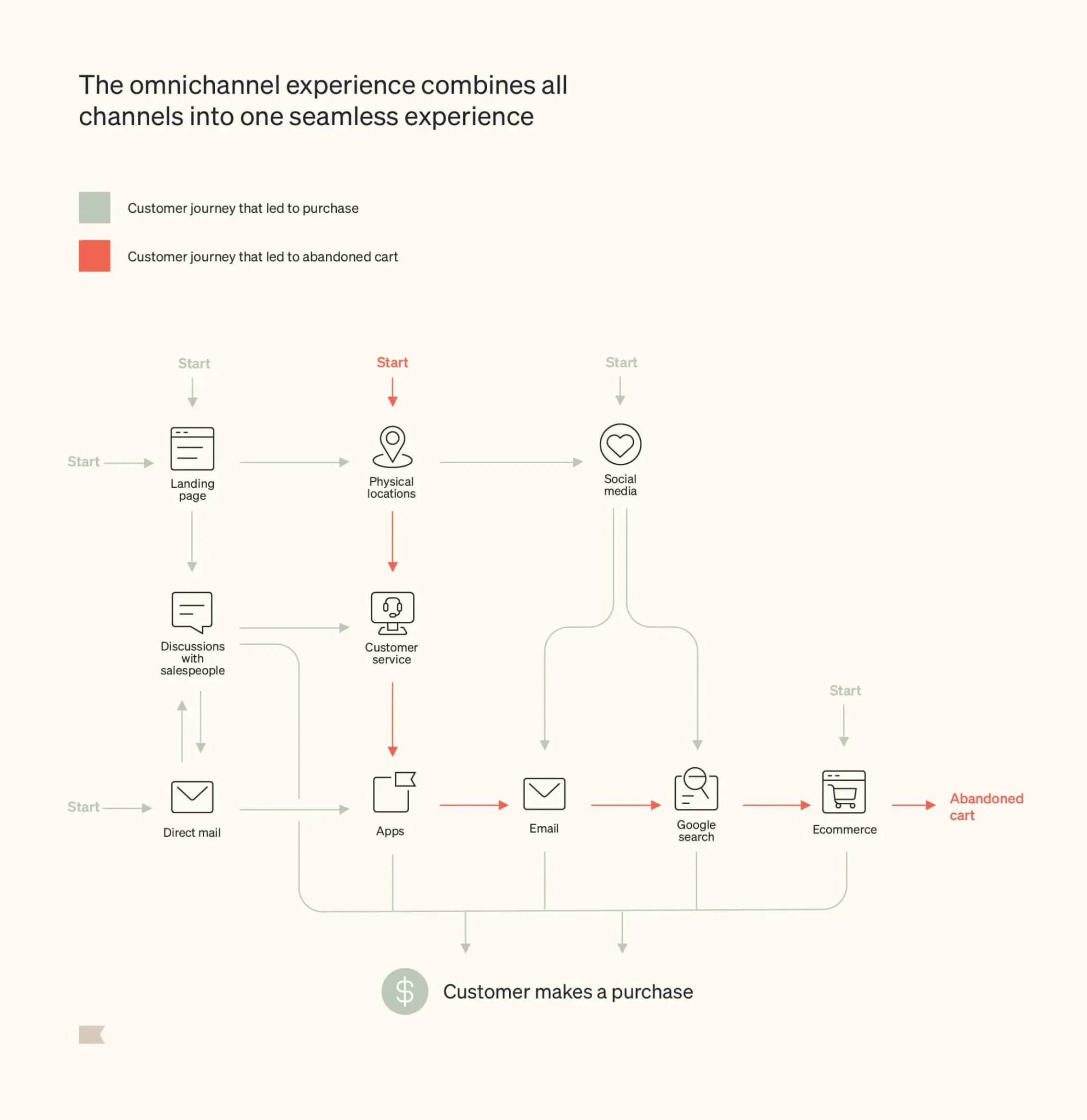
Image source: Klaviyo
The core pillars of an omnichannel strategy
Before you start thinking about which channels to add or which tools to invest in, you need to get the foundations right. An omnichannel strategy is only as strong as the pillars holding it up. When we audit D2C brands, we tend to find that skipping any one of them shows up in the customer experience pretty quickly.
Unified customer data
This is the non-negotiable starting point. Bringing customer data from your CRM, ecommerce platform, loyalty programmes, and marketing automation into a single view eliminates silos and gives you the insights needed to improve customer satisfaction and engagement.
Without unified data, every other pillar becomes significantly harder. You can't personalise if you don't have a complete picture of who you're talking to. You can't coordinate channels if each one is pulling from a different data source. A unified customer profile that captures behaviour, purchase history, preferences and engagement across all touchpoints makes everything else possible.
Channel integration
Onceyour data is unified, your channels need to start talking to each other. That means bringing together every channel you currently use to reach your target audience, alongside any channels your customers have shown they prefer. You will be able to run promotions that work across multiple sales once you’ve connected your online store, physical locations, mobile apps and social media platforms into a single ecosystem.This is where you also might discover your biggest gaps, because what happens on one channel needs to inform what happens on the next.
Personalisation
Thereal value of omnichannel starts to show up in your numbers here. Unified data and connected channels can lead to experiences that feel personal. We’re not talking first-name-in-the-subject-line personal, but relevance based on what your customers have done, bought, browsed or ignored.
Product recommendations, segmented campaigns, and tiered promotions all result in higher conversions and loyalty.You want every customer to feel like your messaging was written specifically for them, even when you're sending at scale.
Consistent brand identity
Even with personalisation, each touchpoint should never look and feel completely different. Brand voice, visual identity, and core value proposition need to stay consistent across all the variety in your messaging. Really nailing omnichannel marketing means your brand never gets lost in the mix. Sure, different channels require different approaches, but you don’t want to use Gen-Z slang just for Instagram when you’re presenting yourself as a premium brand on your website, because your shoppers will never know who you are and where they fit. Consistency builds trust and generally makes more sense for the buyer journey.
Agility and automation
There’s no marketing strategy that you can just set up and leave unattended. And this is especially true for omnichannel. You need predictive insights, automation and real-time engagement that responds to customer behaviour instantly to stay ahead. Automation is the ticket here, so you can keep delivering the right messages at the right time without manually orchestrating every single one. Agility is then what allows you to learn from your data, iterate quickly, and keep improving the experience.
What omnichannel marketing actually looks like in practice
Part of building a good omnichannel strategy is knowing where each channel earns its place. I’ve said again and again that you don’t want channels for the sake of it, but we do recommend covering the bases and making sure your brand shows up across the following (if relevant):
Paid social (Instagram, TikTok, Facebook): This will primarily be where new customers discover you and where you bring back people who've shown interest but haven't converted yet. For most brands, web traffic starts here.
Your website: The hub of your whole journey. This is where warm leads go, consideration happens, purchases are actually made, and the data that powers everything else is collected.
Email: The workhorse of retention in my opinion. Welcome flows, post-purchase emails, product education, loyalty campaigns, basically anything that benefits from a bit more space to tell a story. Email needs to be in sync with your other channels because you can only build your list outside of it.
SMS: Texts aren’t dead yet, I promise you. Time-sensitive nudges like expiring offers, back-in-stock alerts or replenishment reminders cut through when used sparingly.
Push notifications: These are great for app-based brands wanting to reach customers in the moment. Like SMS but even more urgent. Flash sales, personalised recommendations, delivery updates etc.
WhatsApp: Text isn’t dead, but WhatsApp is where most of us are. It’s getting increasingly effective for conversational, two-way interactions as well, particularly for higher-consideration purchases where customers have questions.
Why it's important to have a unified platform to build your omnichannel strategy
You can have what looks like the best omnichannel strategy in the world, but if you're trying to execute it across five different tools that don't talk to each other, you're going to hit a wall pretty quickly. This is one of the most common and costly mistakes I see brands make when they start scaling their marketing.
It’s like everyone's doing their job, but nobody has the full picture. And when nobody has the full picture, the customer experience suffers because the decisions being made on each channel are being made in isolation.
This is why the platform you build on matters as much as the strategy itself.
A truly unified platform means your campaigns, automations, segmentation and reporting all live in the same place, informed by the same customer profiles and executing against the same strategy. In practice, that means:
No more data silos. When a customer makes a purchase, that signal immediately updates their profile, suppresses them from a promotional flow, triggers a post-purchase sequence, and adjusts the audience segment they sit in, all without any manual intervention.
Full visibility across channels. When someone engages with an email but not an SMS, that behaviour is visible and actionable.
A single source of truth. When you're planning a campaign, you're not cross-referencing data from multiple platforms and hoping it's in sync. It just is.
Less room for error. Every integration you maintain between platforms is a potential point of failure. Every time data moves from one tool to another, there's a risk of it being delayed, duplicated or lost entirely.
A more efficient team. Managing multiple disconnected tools is expensive in money, time and the load it places on your team. Your people spend less time managing tools and more time building better campaigns, understanding customers more deeply, and making sure your brand identity is consistent across every stage of the journey.
This is exactly what Klaviyo's Data Platform is built to do. Rather than stitching together separate tools through integrations, it gives you a single, real-time view of every customer across every channel. That unified foundation is what makes everything else in your omnichannel strategy actually executable, rather than just theoretically possible.
Your omnichannel strategy is only as good as the infrastructure supporting it. Everything else becomes significantly easier to execute when you get the platform right.
Klaviyo features to supercharge your omnichannel strategy
So far I've talked strategy and principles, but what about the practical stuff that brings an omnichannel strategy to life. If you're building yours on Klaviyo, there are loads of features specifically designed to make the whole thing work harder and smarter. These are some of the most useful, in my humble opinion:
Omnichannel Campaign Builder
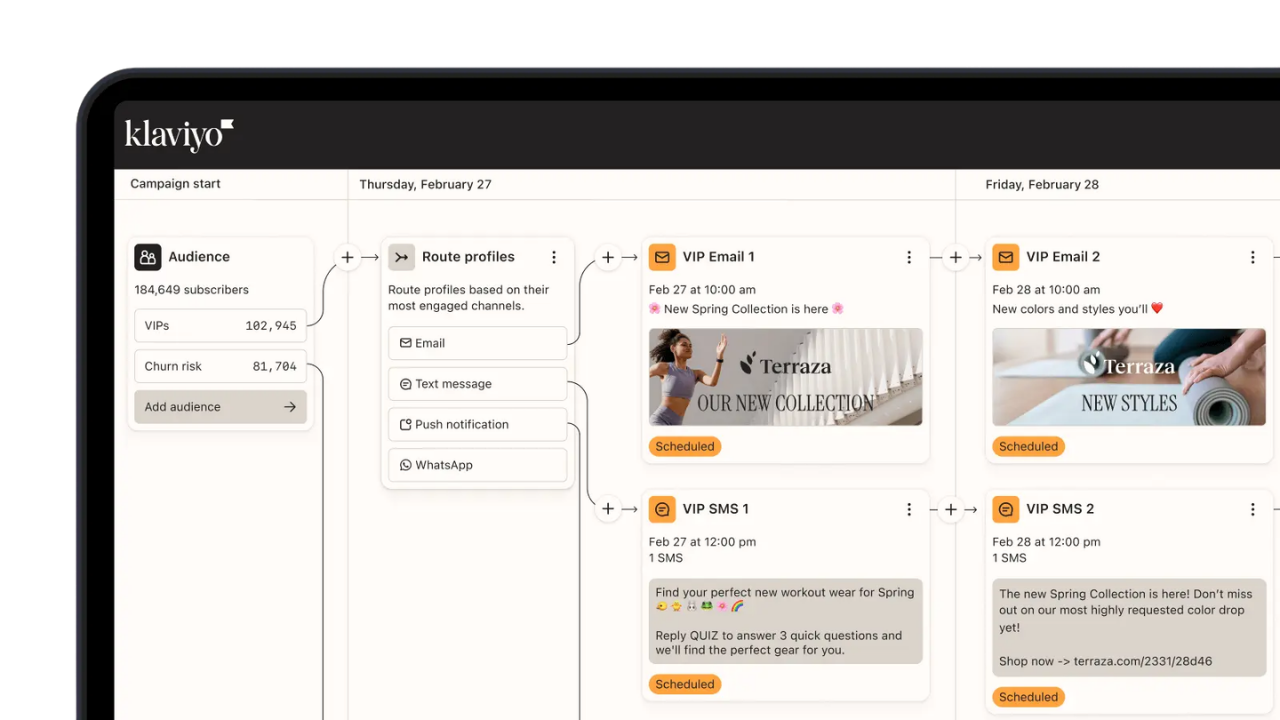
This is the feature that changes how you plan and execute campaigns across channels. Rather than juggling disconnected systems and manually syncing data, you can have a single campaign canvas inside Klaviyo to plan, launch and measure multi-day, multi-message, multi-channel campaigns across audiences and touchpoints.
Here's what that looks like in practice:
One visual workflow for email, SMS, push and WhatsApp, with calendar and list views to help with planning
Multi-audience orchestration so you can send tailored messages to different segments within the same campaign without duplicating work
Real-time performance monitoring across every channel and send time from a single reporting view
One of the even more useful things you can do inside the builder is set follow-up messages based on how customers have acted. So you might send an email to your full audience, then automatically trigger an SMS only for the people who didn't open it. Klaviyo sets up the right audience filters for you, so building those kinds of multi-step cross-channel sequences is very quick, I’m talking minutes instead of hours.
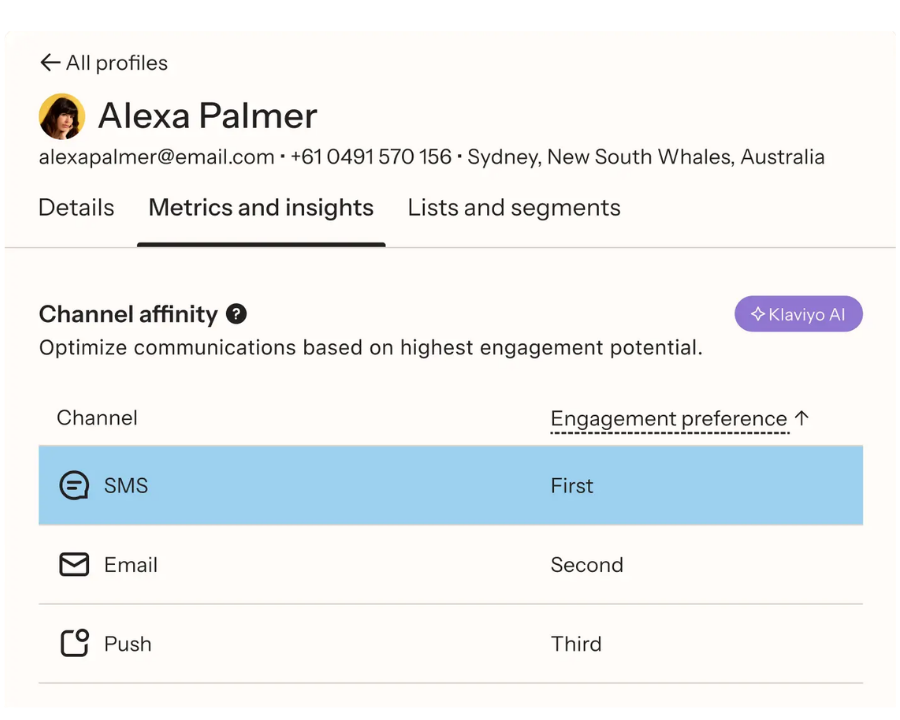
Channel Affinity
Rather than making blanket assumptions about how your customers prefer to be contacted, Klaviyo's channel affinity feature uses a machine-learning model to rank each customer's preferred channels by expected engagement. Those insights can then be put to work across:
Segments, so you can group customers by their preferred channel
Flow filters, to make sure messages only reach people through the channels they're most likely to engage with
Conditional splits, to send people down different paths in a flow based on their preferences
The model re-evaluates every two weeks so it stays current as customer behaviour changes. That all means better engagement, less fatigue, and fewer unsubscribes caused by targeting people in the wrong place at the wrong time.
Audience Optimisation
Even with great segmentation and channel strategy, there's always a risk of messaging people who are on the verge of disengaging. Audience Optimisation uses a predictive model to estimate each recipient's likelihood of unsubscribing and removes the highest risk profiles before a campaign goes out. A few things worth knowing:
It looks at engagement history, onsite activity and broader sending patterns to make its predictions
It is not the same as suppression. It evaluates a single campaign and only removes the highest risk recipients for that specific send. Those same people might still receive different content or future campaigns
There's a cool-off safeguard built in, so, if a profile hasn't received any messages in the past 30 days, their unsubscribe risk is temporarily reset, creating a natural opportunity to re-engage them with more relevant content
Campaigns that used Audience Optimisation are marked with a lightning bolt icon in your campaign list so you can identify them at a glance
Multi-Touch Attribution
Last-click attribution tells you what sinched the sale but not what got you there. Multi-touch attribution give you visibility into how every message contributed to a conversion across:
Email
SMS
Push
WhatsApp
This matters enormously when it comes to budget decisions. If your SMS is warming people up and your email is closing, you need to know that. Otherwise, you risk under-investing in the channel that's doing the most heavy lifting.
All together, these features represent what a truly unified omnichannel platform can and should look like. That is, one place to plan, one source of customer truth, AI that adapts to individual behaviour, and attribution that reflects the full journey. That’s the infrastructure that makes a great omnichannel strategy actually executable.
Integrations
One of the things that makes Klaviyo particularly powerful for omnichannel is how well it connects with the rest of your tech stack. The platform integrates with hundreds of apps, so the data flowing into Klaviyo doesn't have to come only from your email and SMS activity.
A good example is the Meta Business Suite integration. When connected, you can sync your Klaviyo segments directly to Meta to build lookalike audiences based on your best customers, and any leads collected through Meta ads can be sent straight into a Klaviyo flow.
So someone who engages with your ad on Instagram can move seamlessly into a welcome sequence without any manual work on your end. That's the kind of interconnected thinking that turns just a multichannel presence into an omnichannel one.
The same principle applies across the rest of your tech stack. Klaviyo integrates brilliantly with:
Loyalty platforms like LoyaltyLion and Yotpo, so loyalty activity and reward milestones can trigger flows or update segments automatically.
Review tools like Okendo and Stamped to ensure post-purchase review requests are timed and personalised based on what someone bought.
Subscription apps like Recharge and Skio, so subscriber status, upcoming renewals and churn risk all feed into your retention strategy.
Helpdesk tools like Gorgias, keeping customer service interactions visible alongside marketing data.
Ecommerce platforms like Shopify and BigCommerce, which form the backbone of the whole setup, syncing purchase history, product data and on-site behaviour in real time.
Every integration you add is another data source feeding into your customer profiles, making your segmentation sharper, your personalisation more relevant, and your overall strategy more connected.
Final thoughts
Building an omnichannel strategy is an ongoing commitment to meeting your customers where they are. You don’t need the biggest budget in the world or more channels than any other brand. You just need to have invested in the right channels (for your audience) and have the right foundations in place to bring them together: unified data, connected channels, tools to act on both intelligently (ie, a platform that provides all three).
Continuing to run email, SMS and socials with separate workstreams will seriously widen the gap between where you are and where your customers.
Closing this gap doesn’t have to be scary and overwhelming either. Focus on the fundamentals for now, get your data working for you, and build from there (which might look like bringing on an extra team to help).
If you're doing it in Klaviyo, you're already working with a CRM built for exactly this. And if you’re looking for a team to help you pull the most value out of the platform, as a Klaviyo Platinum Partner agency, we’re well-equipped to help.
Get in touch to learn more.