

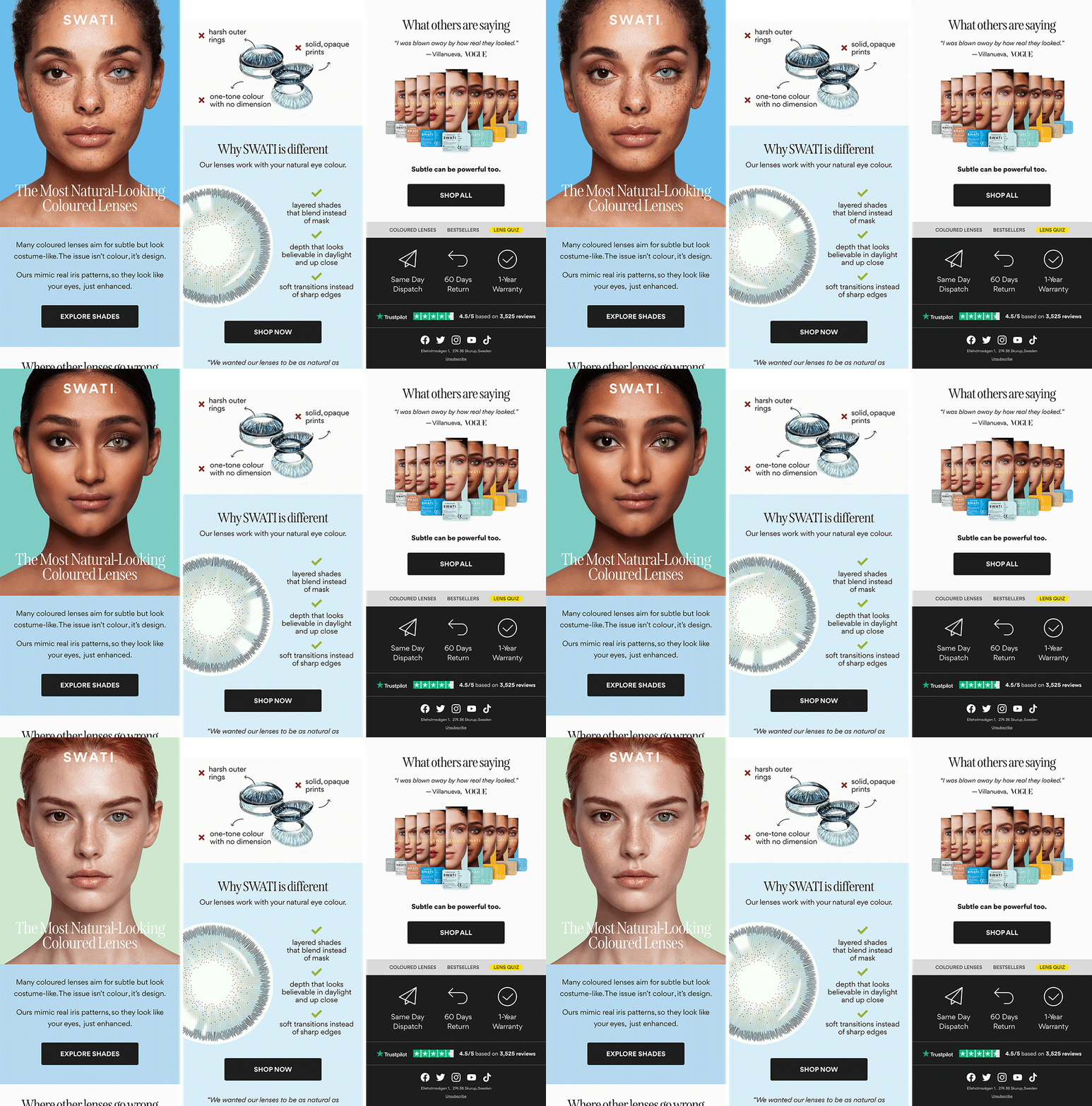
Email personalisation strategy for a global contact lenses brand
SWATI EU Case study: Turning abandoned checkouts into more personalised purchasing experiences
After building an abandoned checkout flow for SWATI’s EU market, we saw an opportunity to make the experience more personal.
We developed new, contextual email variants using cart data and tested them against our original versions. Both new variants won, increasing clicks and conversions.

Our Approach
To build on our original flow, we developed a new set of emails around contextual product recovery. At this stage of the journey, the customer has done a lot of the deciding, so we used basket and catalogue data to shape the content of each message and reignite interest.
What we did:
Connected Klaviyo checkout event data with Shopify catalogue information to pull product titles, images and descriptions.
For the second email, we created a cart overview with short descriptions, followed by more detailed product blocks to help customers revisit their choices.Prioritised blue and green coloured lenses (the hero products) over accessories in the visual layout.
Reworked the discount logic to recognise offers already applied at checkout. The new emails reinforced existing savings or presented a 10% discount where relevant.
Made savings clearer by displaying original prices, discounted totals and monetary savings directly within the email.
Refined the design with a clearer visual hierarchy and direct checkout links to make returning to purchase more straightforward.
The Brief
SWATI, a global coloured contact lens brand, came to us for help with their abandoned checkout experience. We built them a two-email flow that did the essential job of reminding customers that they had left something behind. It reached shoppers at a point of real intent. However, we soon realised little use was being made of the information available in each checkout. The products. The cart value. The discounts that might have already been applied.
We decided to test this against a more contextual abandoned-checkout experience to see if had an impact on core metrics. These customers had already shown they wanted to buy, so each email needed to make their products easier to recognise, evaluate and justify, while giving a reason to return to checkout.
The Outcome
We A/B tested the contextual emails against our original versions, and both tests ended in favour of the contextual experience.
100%
increase in revenue in first abandoned checkout email
53%
increase in conversion rate in first abandoned checkout email
134.57%
increase in conversion rate in second abandoned checkout email