

The role of AI in customer personalisation: from static segments to predictive customer journeys
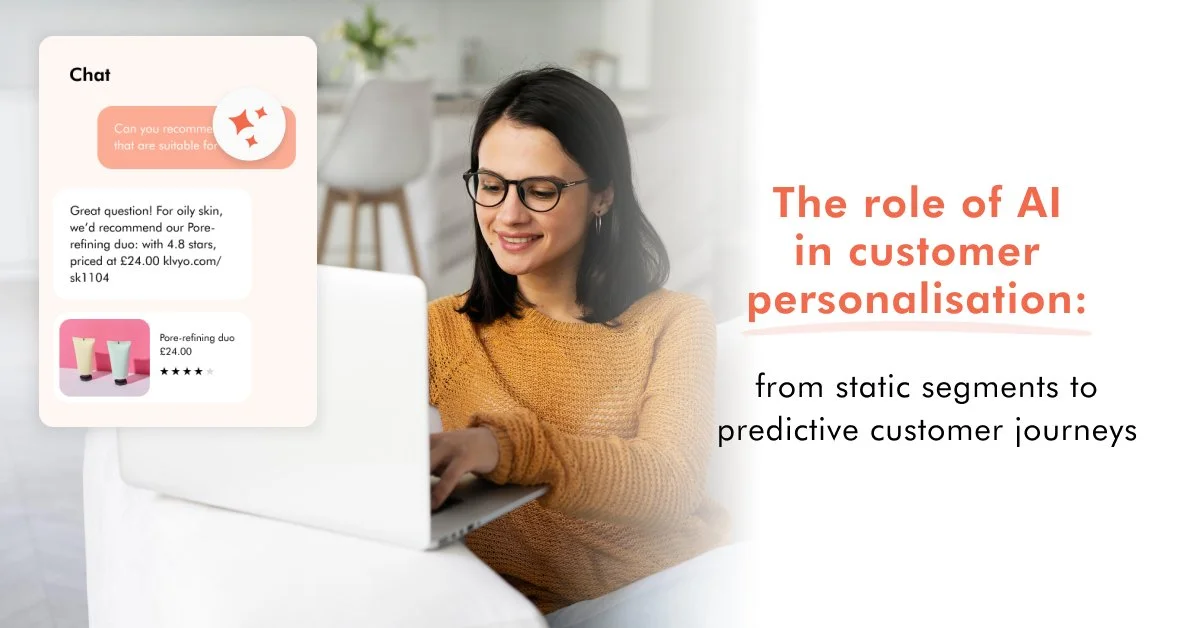
When marketers hear "AI personalisation," the mind usually jumps to automated subject lines or dynamically generated product copy. It's an easy, and not unreasonable, association to make. Generative AI has made these things faster and, in many cases, better.
But content generation is arguably the smallest part of what AI can do for CRM and retention marketing. Its more valuable role is interpreting customer behaviour and predicting what's likely to happen next, then using that prediction to decide which experience, message, offer, channel, timing (or whatever) is most relevant to each customer.
That shift from static segmentation to predictive customer journeys changes how retention marketing performs. Here's how to put it into practice.
What is AI personalisation?
Broadly, AI personalisation refers to the use of machine learning and predictive models to tailor content, product or experience decisions to the individual (rather than applying the same treatment to everyone). It spans everything from the recommendation engines behind Netflix and Amazon to dynamically generated ad creatives.
In the context of CRM and retention marketing specifically, it refers to the use of predictive models to shape a customer's experience.
Conventional personalisation relies on known, historical data (informed by a customer’s past actions): first name, purchases, location, a segment a customer was manually placed into. It's useful but static. A customer sits in a segment until someone manually moves them, and everyone within that segment is treated the same regardless of how their behaviour is trending.
AI personalisation works differently. Instead of reacting to what a customer has already done, it uses their data (browsing behaviour, purchase frequency, engagement patterns, recency) to predict what they're likely to do next, and adapts the marketing around that prediction.
Rather than described by their history, the customer is modelled by their trajectory.
From static segments to predictive customer journeys
Traditional segmentation asks fairly narrow questions. Someone purchased twice? Okay, they're a repeat customer. They haven't purchased in 90 days? So, they're at risk of churning. These are useful starting points, but they're binary and based on behaviour that has already happened. They tell you what happened, not what might happen next.
Predictive personalisation asks different questions:
How likely is this customer to purchase again, and when?
What are they likely to buy next?
How valuable are they likely to become over time?
How likely are they to churn, and how soon?
Once you have those signals, they can shape the customer journey. Instead of every customer in a "repeat customer" segment receiving the same flow, the content, timing, offer and even channel can adapt based on where that individual customer sits on their own predicted path.
Two customers might both be in a "high value" segment today, but if one is predicted to purchase again within a week and the other within two months, treating them identically wastes an opportunity to be more relevant to each.
This is the main difference between static and predictive personalisation. Segments describe who a customer is; predictions describe what they're likely to do.
How AI personalisation works in Klaviyo
Klaviyo has built a useful set of tools for getting the most out of AI personalisation. These are some of our favourites:
Predictive Analytics
Klaviyo can calculate predictive metrics for individual customers, including predicted customer lifetime value, predicted number of future orders and expected next order dates. These aren't pulled from a single data point either; they're modelled from that customer's purchasing patterns and the wider behaviour of similar customers on your list.
This means you can build flows and campaigns around signals that look to the future, rather than historical ones. For example, you can prompt a customer whose expected next order date is approaching, and do so at the perfect moment, rather than on a fixed 30-or 60-day cadence.
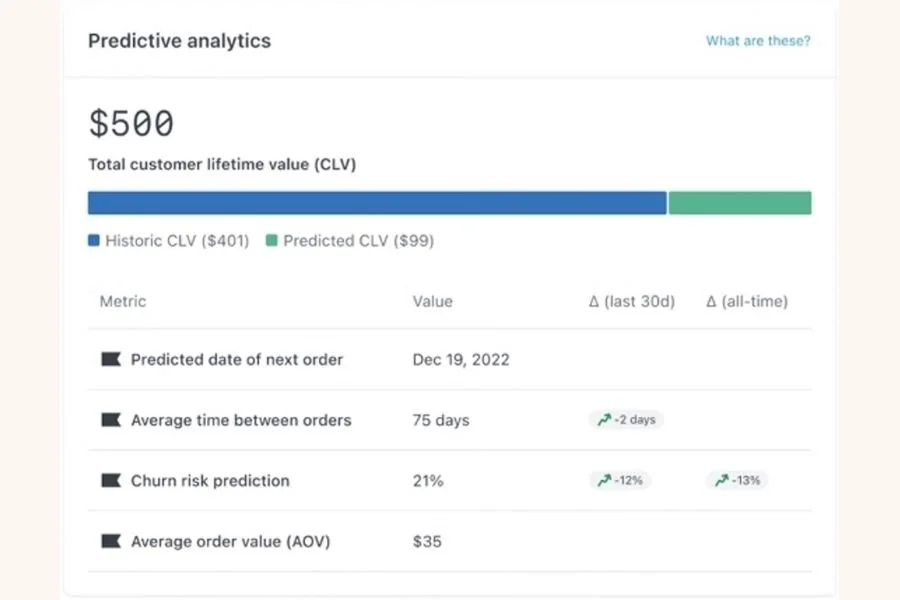
Image source: Klaviyo
Predictive Product Recommendations
Klaviyo's personalised product feeds use an individual's browsing and purchase behaviour to surface the products they're statistically most likely to be interested in. The Next Best Product function offers targeted cross-sell recommendations based on their previous choices.
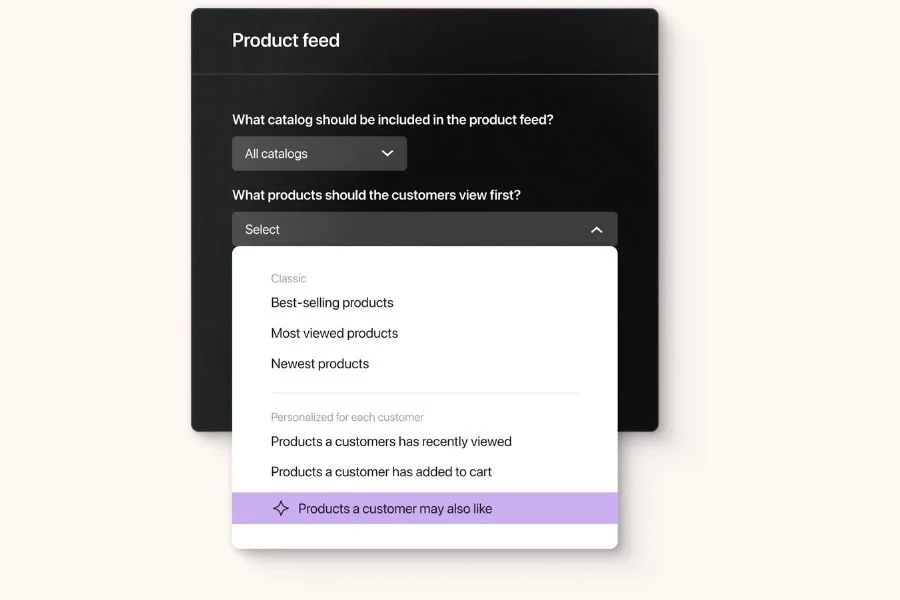
Image source: Klaviyo
RFM and Flow Personalisation
Klaviyo's RFM (Recency, Frequency, Monetary) segmentation can be combined with dynamic content and flow splits so that customers in different behavioural groups experience different journeys. A loyal, frequent customer, a recent first-time buyer, and a customer showing early churn signals shouldn’t need to see the same email, the same offer, or the same send frequency. With RFM feeding into flow logic, they don't have to.
A few tangible examples of what this looks like in practice:
Winback timing adjusted based on an individual's churn risk score, rather than a blanket "60 days since last purchase" trigger.
Higher-value or more premium product recommendations shown to customers predicted to have high lifetime value.
Cross-sell offers from Next Best Product data and not just fixed "customers also bought" lists.
Discount thresholds reserved for customers who show real churn risk, rather than applied broadly across an entire segment.
None of this requires marketers to rebuild segments manually every time behaviour shifts. The prediction updates as the customer's behaviour changes, and the journey adjusts with it.
Why AI personalisation matters for retention
The value of predictive AI personalisation shows up directly in retention performance.
Retention marketing is, at its core, a series of guesses about timing and relevance. When is this customer likely to buy again? What would actually make them come back? How much of an incentive do they really need? Static segmentation makes those guesses at a group level and hopes they apply to most people. Predictive personalisation makes them at the individual level.
This manifests in a few ways:
More relevant customer journeys. Decisions are based on individual behaviour rather than broad assumptions, which means fewer customers receive messaging that doesn't reflect where they actually are.
Better timing. Reaching customers closer to when they're actually likely to act, whether that's before a repeat purchase or at a churn risk moment, rather than on a fixed schedule that happens to apply to everyone in a segment.
Smarter incentives. Discounts and offers can be reserved for customers who need the nudge, protecting margins while still supporting customers most at risk of disengaging.
More scalable personalisation. Sophisticated, individually tailored journeys without the operational burden of manually building and maintaining hundreds of narrow, static segments.
Together, this is less about sending smarter emails and more about an entire strategy that adjusts itself and doesn’t need to be rebuilt every time there’s a plateau.
Best practices for AI personalisation
Unfortunately, getting value from predictive personalisation isn't just a matter of switching it on. Here are a few tips from our Klaviyo experts worth keeping in mind:
Start with good data.
Predictive models are only as useful as the data feeding them. Make sure your customer history is complete and aggregated across the platforms you’ve used over time. If, for example, you’ve migrated to Shopify from another e-commerce platform, verify that historical purchase data has moved with you. Missing past orders or customer activity will limit the accuracy of predictions like CLV or churn risk.
Use predictions to improve strategy, not replace it.
A churn score or predicted CLV is a signal, not a strategy. It still needs a sensible customer experience built around it, the right message, the right offer, the right tone. Don’t treat it as the whole solution.
Test predictive vs conventional approaches.
It's tempting to assume an AI-powered flow will automatically perform better than the one you manually set up and sent live. And sure, sometimes it will. Sometimes the difference is marginal too. But sometimes a simpler, well-timed manual input works just as well. Keep testing to make sure your marketing is grounded in real performance and not assumptions.
Don't over-personalise.
Predictive data is powerful, but not every touchpoint needs to be hyper-customised. Use it where it will obviously improve the customer experience: better timing, more relevant recommendations, and appropriate incentives. Don’t personalise just because the data is available.
What to do now
You don’t need to rebuild your entire CRM strategy around AI overnight. Start with a few practical tests to gauge what would be most beneficial to your team and workflow:
1. Replace fixed timing with predictive signals
Take a flow that currently relies on a set delay, like winback, and test an RFM-based trigger instead. For example, trigger the flow when a customer moves into Klaviyo’s “Needs Attention” RFM group, so they enter as soon as their behaviour suggests they’re becoming at risk rather than after an arbitrary number of days.
2. Add predictive recommendations to your cross-sell emails
Try implementing Klaviyo’s personalised product recommendations or Next Best Product in place of static “customers also bought” blocks. This recommends what that individual customer is most likely to want next, rather than what generally sells well alongside their previous purchases.
3. Test when each customer is most likely to engage
Test campaign scheduling around when recipients are most likely to open. Compare the results against your usual campaign send times and see which approach wins.
Predictive personalisation is only useful when it measurably improves performance. Start with one or two flows or a test block here and there. You don’t need to implement everything just because the technology exists.
Final thoughts
The real evolution in CRM marketing won’t come from getting AI to write all your emails and do all your laundry (although the latter would be nice). The bigger opportunity is using AI to help you move beyond predefined customer journeys and respond to what each customer is likely to do next.
Static segments still have a place and won’t go anywhere soon. They're simple, transparent, easy to build, and necessary in some situations (first names, order numbers, etc.). But they describe a customer's past. Predictive personalisation describes their trajectory and lets you act on it before the most crucial moments have passed.
At Melusine Studio, this is where we spend most of our time with clients. We implement Klaviyo's predictive tools and build the strategy and flow logic around them so personalisation improves retention, rather than adding complexity.
If you're looking to move beyond static segmentation and build customer journeys that respond to real behaviour, contact our bespoke team of Klaviyo experts.