

Retention strategies for high-AOV brands: How to build loyalty between purchases
There are plenty of advantages to being a high-average-order-value brand.
When a customer is spending £500, £1,500 or even more on a single purchase, it can give brands more room to absorb acquisition and fulfilment costs without those fixed expenses taking up quite as much of the sale.
But with that comes a smaller customer pool, higher expectations and lower conversion rates, all of which means customers are unlikely to come back and buy every few weeks.
Where a lot of high-AOV brands go wrong is treating the next purchase as the goal. But for a brand whose customers may not need, want or be able to justify regular purchases, that's the wrong race to run. Here’s how you should approach retention as a high-AOV brand.
Why conventional retention advice fails high-AOV brands
You’ll probably find that most retention advice online is written for brands with short repurchase cycles. Skincare, supplements, snacks, anything you'd expect a customer to subscribe to without much persuasion.
Weekly discount codes, loyalty points, "we miss you" flows every 30 days all work when the buying cycle is naturally short. But the same logic can’t be applied to a brand whose customers might not need to buy again for a year, or five.
Sending "come back and shop" messages to someone who bought a sofa six weeks ago reads like you don’t know your customer. If you push too hard during the natural cool-off period from a purchase you risk turning what should feel like a premium relationship into a desperate string of promotions.
For high-AOV brands, retention is less about how often you can generate the next purchase and more about what happens between each one. The goal is to maintain confidence in the original purchase, deliver value from it, recognise your best customers and stay relevant until there's a reason to buy again.
Define retention around the category buying cycle
Before you can build a retention strategy, you need a working definition of "retention" and "churn" for your brand and that must come from your data.
The average churn rate for an e-commerce brand can run as high as 70%, but that’s close to meaningless without category context.
Cohort analysis of your own purchase history will show exactly when the odds of a repeat purchase start dropping off. For many DTC brands, it’s around 30-60 days. For high-AOV purchases, it's much longer. Which is fine, just as long as your flows and metrics are built around your numbers and not random benchmarks.

Reassure first and sell second
The post-purchase window matters for every brand, but it carries extra weight when the order is a big one. A customer who's just spent a lot of money wants reassurance that they made the right decision and they’ll likely be paying close attention soon after. Post-purchase emails see open rates of around 60%, well above the 49% flow average. Pair that with one in five consumers saying they'll walk away from a brand entirely after a single bad experience and you’ve got some serious pressure on how you live up to post-purchase expectations.
Our tip here is to lead with clarity, not cross-sells. Confirm their order, set honest delivery expectations, make support easy to reach and address anything specific to what they bought, like warranty, care, installation and returns.
"Thank you, here's 15% off another one" is not the most valuable thing you can say to someone who just spent £2,000 on a piece of tech. First, make them feel good about the purchase they just made.
For the full sequence, read our Anatomy of a Post-Purchase Flow: A Complete Guide for DTC Brands.
For high-AOV categories, that early window should prioritise:
Clear delivery, fabrication or fulfilment timelines (long lead times can lead to anxiety creeping in)
Product education and care content relevant to what they bought
Easy access to an actual person for customer service if possible
Then, always deliver value before asking for another order. Once the transactional messages are done, there's usually a long stretch of relationship left to fill and this is where the product itself becomes part of your marketing.
A fashion brand could show customers how to style what they bought, a furniture brand can send care advice or design inspiration, an electronics brand can share features you might not have discovered yet.
The category changes but the principle does not. High AOV-brands need to give customers another reason to value the purchase before giving them another reason to buy. Every bit of confidence you build here can carry into the next order.
Identify VIPs and churn risk through behavioural data
Most brands tend to have a group of customers spending 4-10x what the average buyer does. But it’s quite easy to lose a slice of them because they get treated like everyone else.
This is where your CRM data really comes into play. Klaviyo's churn models score individual risk using CLV, order frequency and recency, learning each customer's patterns rather than applying a flat rule. You need a decent baseline (roughly 500+ customers with order history) for the modelling to be reliable, but even simple manual segmentation gets you most of the way there on a smaller list.
Once you know who your best customers are, you can target them differently, even in small ways. Tagging a "VIP" profile property onto something as ordinary as an abandoned checkout flow (different subject line, different offer, a note that acknowledges their order history) can lift that flow's value considerably and compound fast at high-AOV prices.
It's also worth separating churn risk by customer type. Someone who spent £5,000 and someone who placed one £80 order eighteen months ago shouldn't land in the same winback journey. And "hasn't ordered in 90 days" isn't specific enough. Something like, "Is this unusual for this customer?" is. Someone going quiet earlier than their own normal pattern deserves attention. Someone who just hasn't hit a generic re-order point doesn't.
Recognition, once you've spotted your VIPs, doesn't need to mean crazy discounts. In premium and luxury categories, the relationship is often built around the experience: early access, priority appointments, private events, personalised recommendations - they all do more retention work than a percentage off.
Tiered programs built around spend rather than discounts have been shown to lift customer spend by 10-15%, and 84% of members in tiered programs say they feel more appreciated than non-members. Recognition, it turns out, can do more retention work than a percentage off.
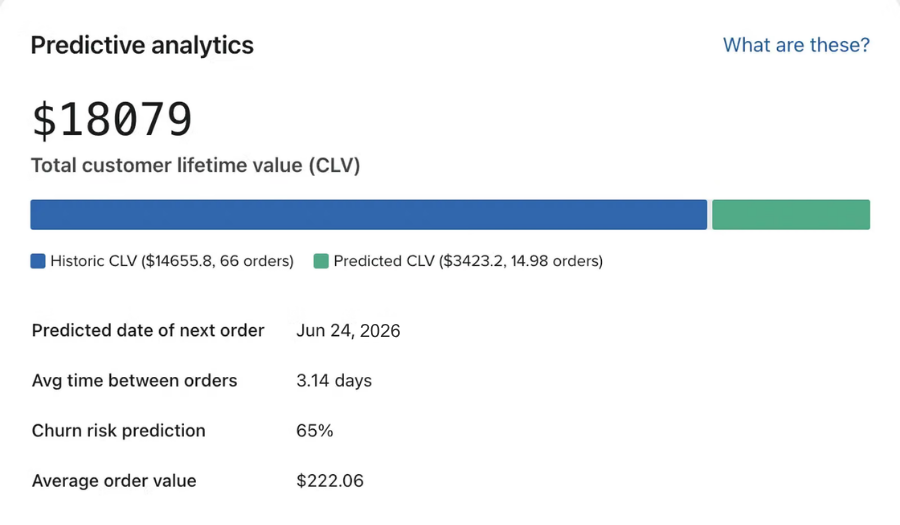
Churn risk prediction model sample in Klaviyo CDP
Measure relationship depth, not only purchase frequency
Repeat purchase rate is the metric every high-AOV brand tracks, and fairly so. But on its own it's a lagging indicator, especially in a category where months or years can separate two orders.
It helps to split what you're actually measuring. Retention behaviour - did they come back? - shows up in repeat purchase rate and customer retention rate. Loyalty - the emotional layer underneath - shows up elsewhere: NPS, engagement with content between purchases, reviews and referrals, loyalty program participation.
You can have solid retention numbers and weak loyalty at the same time. Customers can still buy out of habit rather than preference and leave the second a cheaper option shows up. Watch your engagement metrics alongside repeat purchase rates (mainly because they tend to predict it).
For a high-AOV retention dashboard, track:
Repeat purchase rate, measured against your actual category buying cycle
Engagement trends for your top-value segment specifically
NPS or a lighter satisfaction signal at key post-purchase milestones
Referral and review activity as a proxy for real advocacy
Connect CRM, customer support and feedback
Retention strategy may live largely in Klaviyo, but the signals that should shape it come from across the customer experience.
Support conversations, reviews and returns tell you where customers are confused, disappointed or particularly happy. When that data feeds back into Klaviyo through integrations, profile properties and event data, it can influence the emails and SMS customers receive next.
That could mean suppressing someone with an unresolved support issue from a promotional flow, using review data to trigger a follow-up, or identifying VIP customers using both purchase history and engagement rather than spend alone.
Recurring support questions can also highlight gaps in your post-purchase programme and show you where customers need more reassurance or information.
For a high-AOV brand, that gives you much more useful CRM logic:
Use support and review data to improve segmentation and flow filters
Exclude customers with active issues from inappropriate promotional messaging
Turn recurring questions into better post-purchase education
Use customer value, engagement and feedback together to identify who needs a more personalised experience
Orchestrate email, SMS and WhatsApp selectively
More channels isn't automatically better. 77% of omnichannel consumers already use three or four channels regularly, and pushing every message across all of them can just add unnecessary noise. For high-AOV brands, channel choice should follow intent and urgency rather than a desire to be everywhere at once.
A good split for most high-AOV brands:
Email should be reserved for storytelling, product education, the depth a considered purchase deserves and re-engagement tactics.
SMS only for time-sensitive moments like limited drops, appointment reminders, delivery updates or VIP offers.
WhatsApp for a concierge-style line of communication with your VIP customers where the tone can be more personal.
The channel should follow the message, not the other way around. "Omnichannel" should never just be the same notification landing three times.
A practical high-AOV retention framework
Pull it all together, and a working retention program for a high-AOV brand comes down to these actionable steps:
Map your real buying cycle using cohort data, and define churn against that number.
Reassure before you sell by delivering clarity, product education and easy support access in the weeks right after a purchase.
Segment VIPs, engaged and at-risk customers using CLV, frequency and recency, and personalise the flows that matter most to each.
Swap discounts for access with recognition and service tiers that reward status instead of triggering price-sensitivity.
Connect CRM, support and feedback so what you learn about your customers can directly shape your segmentation, flows and future messaging.
Orchestrate channels by intent using email for depth, SMS for urgency and WhatsApp for your VIP relationships.
Final thoughts
A customer spending more doesn't mean they'll buy more. It means there's more on the line if the relationship gets handled badly.
The best high-AOV retention strategies use the time between orders to reinforce the value of what's already been bought, build confidence, learn more about the customer, and make the next interaction more relevant than the last.
Then, when the customer is genuinely ready to buy again, your brand is already the obvious place to go.
If you'd like help mapping this framework onto your own customer data, that's exactly the kind of work our team does inside Klaviyo every day. Reach out and our boutique team of Klaviyo experts can walk you through what a category-specific retention program would look like for your brand.